

Written by Jenni Doohan, Hampshire Teacher
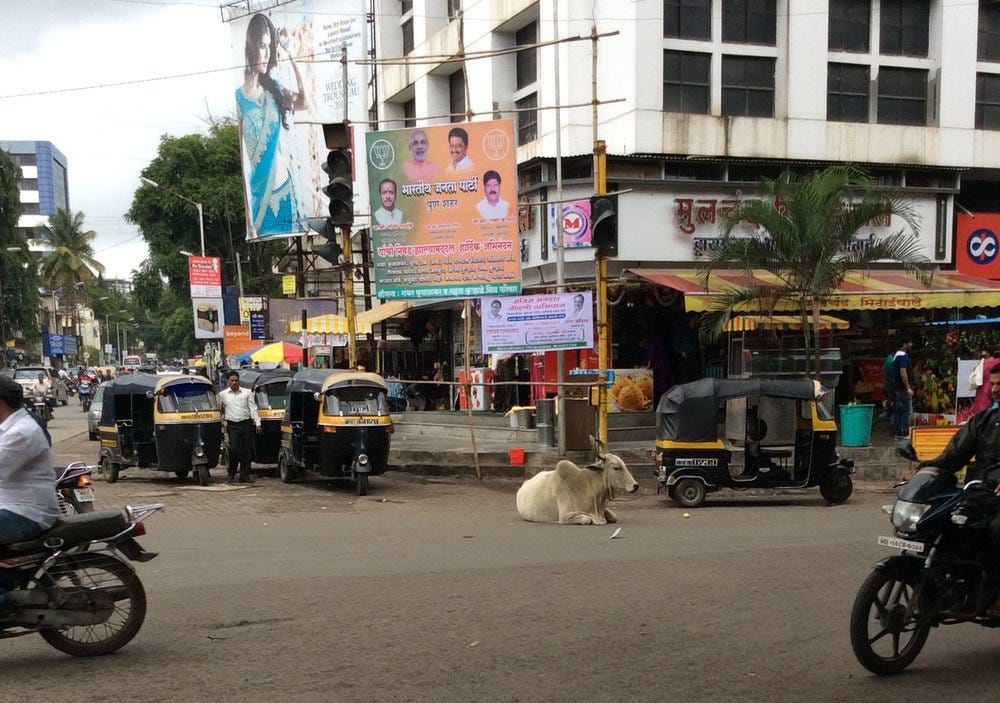
I remember with fondness the ubiquitous presence of the serene cows in the streets and roundabouts in Pune. I was impressed by their implacable indifference to the noisy, colourful, synchronised chaos going on around them. In this article I will be looking at the divine bovine goddess called Kamadhenu, known as the first mother of all cows. The Hindus believe all cattle in the world today are descended from her.
The name Kamadhenu is made of the words kama, which means desire, and dhenu, which means cow. Kamadhenu is the cow of plenty, symbolising abundance and prosperity. Her other two names are Surabhi (meaning “the fragrant one”) and Nandini. Like the goddess Laksmshi, Kamadhenu is regarded as the source of all wealth and fortune in Hinduism. She is closely connected to Mother Earth; all gods are thought to live in the body of Kamadhenu. Illustrations of her often show deities residing inside her. Another common image of her depicts her having a woman’s head and chest, wings of an eagle, and a tail of the peacock.
There are several anecdotes concerning her birth. One states that Kamadhenu rose to the surface, amongst the other treasures, as the devas and asuras churned the ocean of milk in search of amrita, the nectar of immortality. Another story claims Kamadhenu was born from the left side of Sri Krishna to quench his and his consort Radha’s thirst after amorous pleasures.
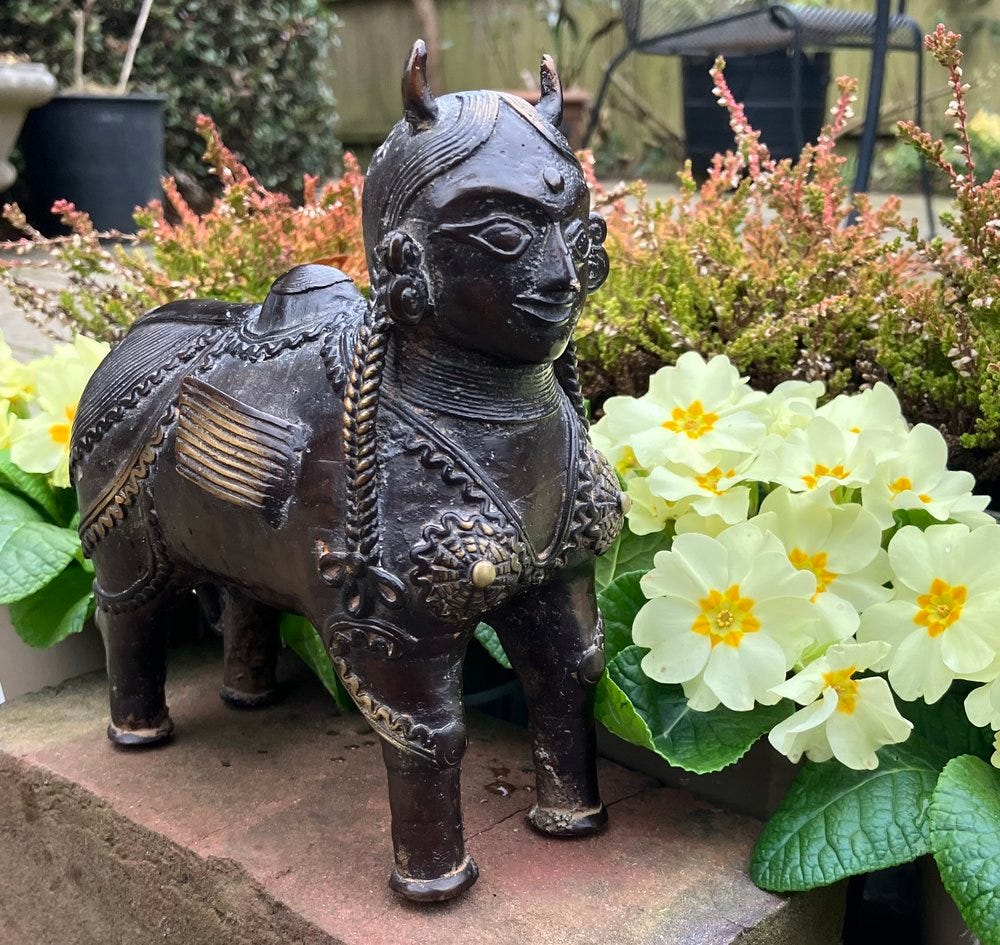
Kamadhenu was made a goddess by Brahma after she offered to worship him for ten thousand years. This tapas won Brahma’s favour, and he created a divine realm for her called “Goloka” and decreed that henceforth all people would worship her and all her offspring.
Kamadhenu has the power to satisfy any wish. This power is valued by all who meet her. In the epic the Ramayana, a celebrated king, Vishvamitra, went hunting with his men in a forest and came upon the hermitage of the sage, Vasistha. The sage hospitably entertained Vishvamitra and all his many men and offered them a colossal banquet after they had bathed. Kamadhenu resided with Vasistha and faithfully served him. She provided all the dainties of the extensive feast. King Vishvamitra was highly impressed by Kamadhenu’s capabilities and wanted to possess her. He offered Vasistha a crore of ordinary cows, horses, elephants and jewels. When his generous offer was declined, Vishvamitra tried to take Kamadhenu by force. Vasistha asked Kamadhenu to produce fighting men. The cow lifted her horns and tail and stood as a fierce and strong figure. From her mouth and various limbs a thousand warriors sprung out, and a ferocious battle ensued in which the large army of Vishvamitra and his hundred sons met with defeat. That was the beginning of the long animosity between King Vishvamitra and the sage Vasistha. We have challenging yoga poses named after each of these powerful figures.
We also have Gomukhasana, the pose of the face of the cow. In this seated pose the thighs are crossed, and the shins are crossed and are neatly folded back; the arms are positioned with one elbow facing the ceiling and the other facing the floor. The fingers are grasped behind the back. Like in most poses shown in Light on Yoga, Guruji remains tranquil and focused in his face. This pose resembles the face of a cow with the knees like the cow’s mouth and the elbows representing the cow’s one ear up and the other ear down. The chest makes up the eyes of the cow.
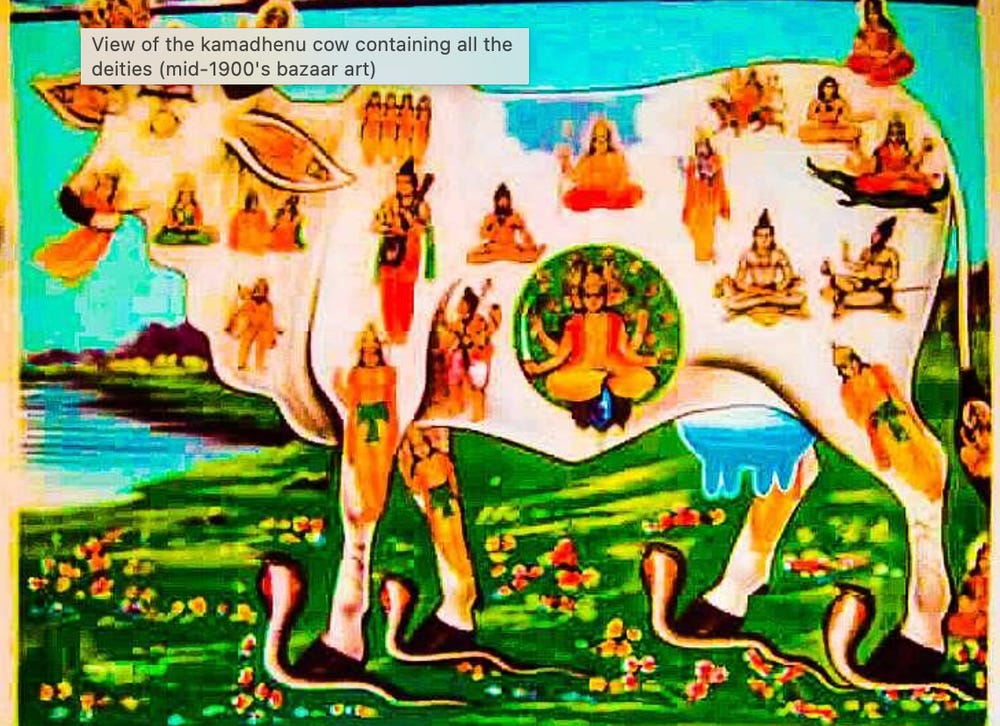
Unlike other Hindu deities, Kamadhenu does not have a worship cult focusing on her, but she continues to be adored and valued through her offspring, the humble cows, who are provided food outside Indian temples and are worshipped on Fridays. The Hindus see each cow as an earthly embodiment of the cow of plenty, Kamadhenu. Perhaps we should all try to emulate her and her daughters’ projection of power and abundance while maintaining a calm demeanour in the face of the world’s challenges that swirl around us.