“What began as teaching English has grown into a deeper journey of connection — through yoga, language, and community.”
Just after the end of the Covid pandemic, I finally decided to reach out to my local refugee support centre, SWVG, and volunteer to teach English to their clients. It felt daunting — I’d never taught anything except yoga — but with the encouragement of my mentor there and a little training, I soon realised that even my small efforts made a real difference. Every Friday I would head down to the centre, meet with one or two students, and begin working through basic English. My students came from many countries, ages, and backgrounds, but they all had one thing in common: they were displaced, far from home, and trying to rebuild some sense of normality and stability. I’ll never forget one woman — a lawyer from Syria who dreamed of retaking her exams in the UK — who needed a counsellor to accompany her to class because of severe PTSD.
The centre itself is an extraordinary place. Alongside English lessons, it offers practical help with asylum applications, medical appointments, and food distribution, as well as activities such as music, art, cooking, and field trips. Most importantly, it provides a safe community space where people can connect, share food, and feel supported. SWVG is a charity supported by donors and other charities. Their patrons include the actress, Miriam Margolyes but 80% of the staff that work for SWVG are volunteers, many of whom take on the role of “Visitors” or “friends of asylum seekers,” visiting people in their accommodation to provide emotional and practical support during what is often a long, uncertain, and difficult process.
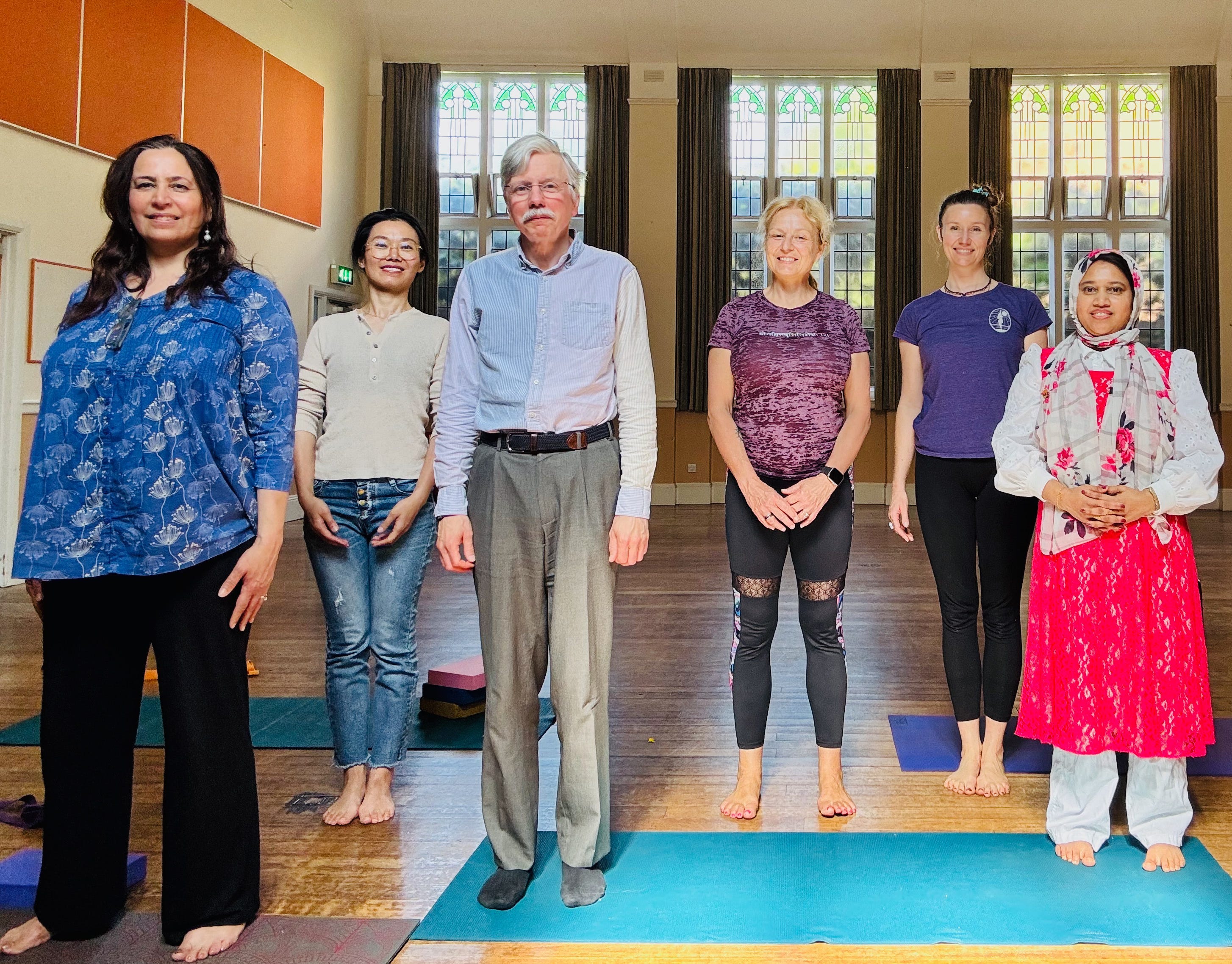
One day, I mentioned to my mentor that I was a yoga teacher and asked whether yoga might be a useful addition to the programme — for both clients and staff. She was immediately enthusiastic, and with funding from the Iyengar Yoga Development Fund (IY(UK)), I began teaching yoga for SWVG in April 2025.
We started simply: a short introduction and straightforward postures, with clear demonstrations so that even those with limited English could follow. I printed out handouts with simple graphics of the poses so that students could practice at home. For me, it was a valuable lesson in refining my own teaching — slowing down, simplifying, and being crystal clear in my instructions.
The classes have quickly become a rewarding part of my weekly routine. Our group is diverse: men and women, younger and older, complete beginners and those with some experience. One young man from Iran, who had practised judo in his home country, was delighted to join in — he proudly told me how much he enjoyed the “stretches” in yoga. Another woman from Syria, who struggles with back pain, hasn’t missed a class since she began. She now even practises at home. The staff who attend also love the sessions; it feels important to give them something nurturing too, as they give so much to others.
Thanks to the support of IY(UK) and their Development Fund, yoga is now a regular activity at SWVG — one that I hope will continue to grow and bring benefit for many years to come.
“Even the smallest effort can make a big difference — sometimes it’s a word, sometimes a yoga pose, sometimes just being there.”